
Tilak
Tilak is a mark on the forehead applied to remind us and others the seat of Intellect. In this web page, you have several read times that it the intellect that draws us closer to awareness. Tilak is applied at the Ajna Chakra, the space between the two eyebrows to 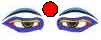 indicate the third eye. Third eye is the spiritual vision, through which you understand that you are that immortal soul (atman) and not the mortal body.
You would have read the symbolism of Snake on Shiva's neck. The snake has eyes which are small and is invisible. The big visible eyes are not real, they are just to camouflage the predators. Similarly our two eyes are not real, which means that they project the world unrealistically. For example, the Sun is not rotating over the Earth but our eyes project as though sun comes up every morning and moves towards west. Similarly things are not really colored, they are just absorption of light at different spectrum.
The physical eyes thus camouflage the reality which is Brahman, the Consciousness. Our real eyes of vision are the witnessing eyes of Awareness. The awareness is the reality but we miss the reality by the false projected world. This is the third eye of Lord Shiva, which is the Eyes of Awareness, which destroys unreality. This is to remind both the user and others to understand the reality of this world.
You should remember this third eye every time you apply a Tilak.
Applying Tilak in the morning is to remind us the whole day that we have to be aware of our Self. The very touch on the area between the eye brows brings the awareness. Touching the area before meditation helps the wandering mind to stay as a feeling connected to the area of the body. When cool sandal wood paste is applied before meditation, it facilitates the attention stay on that area and avoid the mind going away from the body thought.
Purpose of life and spiritual practice is to realize Self. This is achieved by reflection and contemplation in prayer room. But we have to leave the prayer room for our routine worldly duties. So when we leave the prayer room, the tilak in forehead is a remembrance that all our actions in the world is dedicated to the Self. Fore head is the seat of memory. The mark on the head also reminds other person whom we meet to remind of his purpose of tilak, which is to understand that all our activities are oriented to the realization of the Self.
The fingers used for applying Tilak are as follows:
 The ring finger is the finger representing mind and so when one applies tilak to another person the ring finger is used to denote emotion. The base of the ring finger is the mount of sun and so it represent light. Thumb is the finger representing Brahman and so it is also used to apply tilak to denote god’s grace. Since marriage is the emotional binding of two individuals , the groom applies the tilak to the bride with his ring finger, the finger representing mind.
Three major colors of tilak
These are the yellow white and red Viz, sandal wood paste, ash of cow-dung or kumkum (tumeric mixed with lime stone).
 The white ash (Bhasma) is applied on the forehead to remind us that everything that gets created in time and space finally goes into a formless state (awareness) indicating mortality of our body.
The sandalwood paste (Chandan) is applied to indicate the sweet fragrance of the Self in the form of intellect in us.
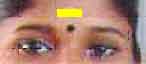 The Kumkum, a red tumeric powder to denote the energy manifestation of Consciousness in this universe. According to Vedic Astrology, Mesh Rasi or the House of Aries is on the forehead. The Lord of Mesh is Mars and His colour is Red. This is why Red Chandan and Sindoor is placed as Tilak on the forehead.
Tilak is sometimes applied as three horizontal or vertical lines indicating the three Gunas, Sattwa, Rajas and Tamas and also the body, mind and intellect that we have to transcend in order to realize our True self.