
Vedas Sakthi
- Details
- Parent Category: Vedas Sakthi
- Category: Vedic Creation
- Hits: 12835
Itihasas and Puranas
Ithihasas and Puranas are one among the other words in Sanskrit that are widely mis-understood in the modern world.
Puranas in Sanskrit means "belonging to ancient or olden times".
Itihasa- In Sanskrit, Itihasa means history
The above definitions are exactly correct, but the understanding of the general public in modern India and the rest of the globe is wrong. Both Purana and Ithihasa are information about past events, but there are differences between the two.
Puranic (Mythical) Itihasic (Historical) Characters:
There are human character's in both Puaranas (Mythical) and itihasas (historical) characters. There are human life incidents in both. For example, we have mythical characters like, Surya Bhagavan or Sun-God, who rides on Seven horses with the central chariot in green color.
There are Ithihasic or Historical characters like Rama and Krishna.
Both Mythical and Historical characters are real, BUT. The Historical characters Rama and Krishna lived in human blood and flesh form and also their incidents happened in the land of India.
The mythical characters are also real but did not live in blood and flesh form. Puranic characters or Mythical characters are representation of Universal phenomenon and their life incidents are real because they represent the Cosmic events.
This mis-understanding has lead great confusion, especially in this time of Rama's Sethu bridge controversy events occurring in 2007.
On what ground is the above fact based?
In the earlier pages we have discussed how Rishi's studied the body and mind of the human and discovered the mysteries of the Cosmic body or Universe. What they found is that the physical nature of human body is similar to the physical characteristics of the universe and the Human mind and the events occurring in the Universe are also similar. Among these two facts, the fact the physical body is similar to the Cosmic physical nature is proved by modern scientists also (See work of Florida University). It may take some more years for Modern science to prove the other fact that the mind of human is the same as cosmic events.
Look how our ancient rishi's told us the Cosmic events through Puranic or Mythical characters. Let us take the same Sun's example.
O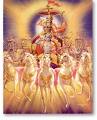 ver In the puranas, a character called Surya Bhagavan (Sun-God) rides on a green chariot with seven horses at a speed of 22,02 Yoganas in half a Nimisha. Is this Sun-God a mythical character and does not exist?
Sun do exist, but not as a human and not riding on a chariot driven by seven horses. These symbolic images convey scientific information on color spectrum of light and on the speed of the light. Speed of light was known to modern scientists only in the late 18th century. But Ancient Indian Rishi's has given that information in Vedic and Puranic texts. The seven horses represents seven colors of light spectrum - VIBGYOR (Violet, Indigo, Blue, Green, Yellow, Orange and Red). The chariot is green because it comes in the center color.
Speed of light: Next interesting fact is about the speed of the Sun's chariot, which is nothing but the symbolic of speed of light. The chariot moves at a speed of about 22,02 Yoganas in half a Nimisha, which when converted into western measurements units will read as 189547 miles per second !! As per the modern science speed of light is 186000 miles per second.
Another criticism is that these facts are interpreted as sicentific after modern scientific discoveries were made in the past centuries. This is not correct. Sayana who was a minister in the court of Bukka of the great Vijayanagar Empire of Karnataka in South India (in early 14th century) interpreted this information well before modern scientist in west could comprehend.
The above example should help to clearly distinct Purana characters from Historical characters like Rama and Krishna, who lived in blood and flesh in human form. Mythical characters like Sun-god are real but do not exist in human form. They are given in human form because the Rishi's understood that the Human body and mind are not different from the Universe.
The beauty of Rishi's finding is that the events occurring in the human is the same in the universe.
Yatha Pindae (Human Body) , Thatha Brahmandae (Universe).
As is the human body so is the cosmic body. - As is the Microcosm (Human) so is the macrocosm (Universe).
This is our strongest connection to the Universe. This became the foundation for Puranas, Ithihasas and Astrology.
Knowing this fundamental basic we will understand whether puranic characters and ithishasic characters are fictional or not. Two legendary heroes Rama and Krishna are ithihasic characters and not mythical.
- Details
- Parent Category: Vedas Sakthi
- Category: Vedic Creation
- Hits: 14264
Eighteen Puranas
The Vedic Mythology
Puranas are Symbolic Language to explain Eternal Truth.
There are 18 puranas compiled by the greatest Genius Sage Vyasa as "Puranas". He used such an brilliant approach of using a real event in history to convey the same message through his historical work, the Mahabharata, the biggest literary work ever composed. The Puranas narrate the history of the various dynasties and hierarchies that emanated from the supreme Consciousness. As a continuation of the lines of Priyavrata and Uttanapada (vide, the doctrine of creation under the Upanishads, above), the world saw the coming in of many heroes, both spiritual and temporal. These offspring of the ancient ones included both the divine and demoniacal natures, which waged a perpetual war between themselves, and much of the Purana content is devoted to descriptions of these conflicts between the Devas and Asuras.
Other than these earlier descendants of the progenitors of the race of all beings, particular mention must be made of the lines of the solar and lunar races of kings and sages, whose lives provide a highly interesting biographical reading of both human and superhuman natures. The history of these dynasties is brought down almost to our own times, thus connecting our present-day existence with the diviner sources from which we have come, as, in the words of the Upanishad, children of the Immortal (Amritasya Putra).
But through these historical events and life of great men, Puranas helps us to understand what is Consciousness, the Mystery of every Human being, whether he or she was in the ancient age or living in this modern age. It is the birth right of every human being to understand the Mystery of Consciousness. The Rishis says the very purpose of Human's life is to realize this Consciousness.
Only with this clear understanding of Body-Sense complex, Mind, Intellect and Awareness can the Puranas be understood without any misgivings. With this simple understanding one clearly understands the Symbolism of all Vedic Gods, rituals, culture and the Purushartha (goal) of Mankind.
Most of the Puranas abound in lengthy narratives of legends glorifying a particular god or deity, delineating his or her incarnations, descriptions of holy places of pilgrimage (Tirtha), vows or observances (Vrata), acts of charity (Dana), and the like, with some shorter or longer references to the process of creation, the genealogy of the gods, demons and kings, stories of Rishis, as well as occasional statements on the foundations of politics, and the arrangement of the continents of the world as parts of the cosmos.
Thus, the Puranas form a general encyclopaedia of popular thought on religion and philosophy. But the Bhagavata and the Vishnu Puranas are a great exception to this rule and they constitute a really splendid literature on a very lofty philosophy and mysticism.
In Vedic tradition, however everything is centered around the main Trinity Gods Brahma, Vishnu and Shiva are the symbolism of the Mind, Intellect and Awareness. Brahma is the creator God, Vishnu the sustainer and Shiva the destroyer. All the three originate from the Supreme Para-Brahmam, the Pure-unconditional Consciousness.
Web sites that give information on the meaning of Puranas,
Another site giving information on the meaning of 18-Puranas,

- Details
- Parent Category: Vedas Sakthi
- Category: Vedic Temples
- Hits: 43063
SAKTHI FOUNDATION – ABN Drugs – Chennai
A trip for transformation
Dear friends when you go to Rameshwaram just spend time to see all these spots and try to connect your own feelings, mind and ideas about the spots with Ramayanama nd personal life. Thus you can transfer atleast one unwanted quality within us. All these spots are surrounded by ocean waters which are still vibrating with several waves of Rama. If you meditate them you can feel that. The sea will sure narrate you the pain of couple’s separation as narrated in many Ramayanas. So just have a relaxed trip.
 Devi pattinam - navagrahas installed by Ram to worship them to tame his mind and thoughts to bring back Sitha. Agaisthya gave him the shlokas of Adithya hridayam in this place where Devi fought with Mahisha once. There are 9 granite pieces installed into the bay water which symbolizes the 9 characters of mind. Water is the mind concept. The palace is very calm and triggers our mind with Ram's vibrations.
These planets are called ''navabashanams'' - bashanam means poison. But when 9 types of poison herbs mix together in proper ration as said in Sidda medicinal texts they cure the illness. Like that 9 characters have to be witnessed and tamed by us to live a happy life.
The place is just 25 Kms from Ramanathapuram and there is a Vishunu temple called ''kadal adaitha perumal'' [photo 3] - one who tamed and crossed the sea. Ram took the abode of Sri.Karuppu samy - Shiva gana to support his actions.[photo 4]
After Rama’s poojas the local people have started considering that spot as auspicious one like how we consider certain places like Dandi, Jalianwalabag etc. Later people have made good structured arrangements for worship.
Thirupullani [above photo]
This is a very calm village with a gigantic temple for Vishnu near Ramanathapuram.
This place is well known as ''Puri of South India''. Lord is celebrated as Aadhi Jagannadha. He is the conscious for the whole cosmos with his pattern Laxmi called SriPadmasanai Thaayar.
Lord is in seated posture with abhaya hastha and he holds conch and chakra. He is adorned with his 2 energies nature - Boodevi and perfection - Laxmi.
This is the plce Dasaratha and his wives on their pilgrimage conducted prayers and puthra kaamesti yagam for having children. Dasaratha prayed that Jaganatha himself must be born to him.
The temple is very huge but visited with very less devotees.
This place is being celebrated by saint singer Thirumangai Alwar of 9th century A.D and it is one among 108 Vaishna Divya Desams.
Still we can see couple worship here for Rahu-Kedu [negative energy of obstacle within us] and perform the yaga for child.
The temple is located at the bank of a big lake called Chakra theertha where lord Varaha washed his chakra after killing the demon.
Pul - darpa grass from sea. anai - bed.
Why it is called as ''bed made of darpa grasses''?
 Rama by special yoga tried to meditate upon the water energy to tame and cross it. So he spread the special sea weeds – sea darpa across the shore nad laid down facing the sea to the east. He placed his right hand to his sahasradhala [top of his skull] and meditated to tame his mind to get the courage to cross the ocean. But the sea – mind dis not listened. So he took his agni astra – wisdom and gave a threat that he will dissolve his mind. This made the sea energy to surrender to him and Rama here came to know about a vaanara called Nala who can construct many water based structures. He got the courage and from this place he started making the sethu. So this place is called Sethu karai – shore from where Sethu starts. We can see the sethu inside the sea when we travel a kilometer in boat. Please offer pithru poojas and chant Rama nama here, enjoy the moods of Ram’s separation. [above photo shows Sethukarai beach with sea darpa grass]
Ramanathapuram - Sethukarai - Sri.Sethu rakshaka Hanuman temple where Hauman's atman is ever residing taking care of Ram sethu, the link between a soul and consciousness. The idol is 5 feet tall, raising the right hand with abhaya mudhra towards the sea where the Ram sethu is under the water. The idol is showing the real skin complexion of a man.
We can see a quiet big Hanuman temple in this spot where it is believed that Hanuman’s atman is residing and taking care of the Sethu Bridge which is the symbol of connection between us and God. Hanuman as the spiritual tutor maintains the bridge within our awareness without washing out in the ocean currents – mind power. On all Chitra powrnami day Aadhi Jaganatha and SriRama have a great abishekam and ritual in this spot till evening.
Sethukarai and protection
On the way to this place try to imagine the days of Ramayanam when vaana army marched towards the sea. Imagine they must have spent the days here to cross the sea. In this spot a Vaishna acharya teach us a lesson about God’s protection to his true faithful devotees.
Aacharya’s disciple asks him, ‘’Sir! Can you show how lord take care of us?’’
Answer, ‘’Sure, when vaana sena came to this place, they were scared about the sea and the task of reaching Lanka. Rama was aware about this. While Rama was meditating about this plans he made Laxmana to boost up the vaana veeras. He encouraged them and cared them without losing their spirit of action’’
Symbol of true saranagadhi
When thaanae cyclone was supposed to struck, were here. We were getting palm fruits from the local woman and gave them the information about the cyclone. One among them said, ‘’Sir, even tsunami waves have never crossed our Hanuman’s shrine! We are cared by him’’
Thirumalairayan pattinam - Jdaayu pureeshwarar
 When Jadaayu saw Ravana kidnapping Sitha and flying he tried to save her back. We all knew how this bird tried his best to save Sitha. Jatayu is the symbol of social responsibility. But on his way suddenly he missed his way and could not see Ravana. So he meditated upon Shiva - self-awareness and saw Ravana's route and followed him. Jadaayu symbolizes the strong struggle from society against any unacceptable behavior.
This incident has been made to remember by our ancestors by installing a Shiva lingam very near to Karaikal called Thirumalairayan pattinam. The shrine is very small on the main road leading towards Nagapattinam and Lord is named as Jadaayu Pureeshwarar.
[above photo – Sethukarai SriHanuman temple]
How to believe?
Ancient hunters who can train vultures, hawks for hunting and communication purposes must be Dasarathas’s friends. Jataayu must have been well aware about the king. When Sitha was taken away by Ravana through the sky above Vedaranyam she was shouting. The hunters must have set Jataayu to fight with Ravana. The instinct within each organism can be clearly read out today. Same way Sampathy vulture must have been sent by the hunters to see Sitha in Lanka. Try to seek the reality through the literature by connecting the facts which we experience today.
Like street dogs, vultures never allow a foreign body to come across their space. In this way Jataayu must have attacked a man – Ravana flying with a woman in unique aircraft across that sanctuary in Kodiakarai.
SriRama paadham – Kodiakaarai
The most interesting place near Kodiakarai is Rama paadham. This place is in the midst of the mangrove shrubs of Vedaranyam shore. We have climbed several steps to see the sacred carving of a foot pair to remark Ram’s arrival to this spot to know the clear cut direction to SriLanka. This place is under the ancient archeological board of the country. We saw many monkeys just sitting around the sacred feet. Sure the descendants of Vaanaras!
From the top of this spot we can have a clear cut aerial view of the east bay with dense shrub forest and salt forms. The place is very calm and vibrating the moods of the great legend. From Kodiakkarai Lanka is 40 Kms.
Near the Kodiakkarai beach we can have the divine darshan of Lord Kodi Kulagar – Lord shiva with beautiful ear rings sang by Sundarar in 9th century.
Vedhaaranyam - Elakku kaatiya Vinayagar
In Vedharanyam we can see a small shrine for Lord Vigneshwara. He is known as ''elakku kaatiya vinayagar'' - Lord who gave the clear destination to SriRam and Laxmana.
 This shows how the epic brothers have made up their initiative steps to find the lost Sitha. When you go to Vedharanyam please try to see this shrine in main market place and witness your own initiative thoughts towards your targets.
Photo above: Navabashana navagrahams in Devipattinam
There are several holy tanks, springs, well, sea in Rameshwaram Island. They are considered to be very sacred to cleanse our body and mind. In uni5 panchabootha concept water symbolizes the mind. The quality of our life is based on the quality of mind's thoughts and actions. So all pilgrimage centers in our nation is connected to a holy water source. This is to indicate the transformation of human mind in spiritual level.
Within Rameshwaram temple there are 22 tanks. Around the temple there are few important tanks. They have named with the characters of the great legend. We feel those characters must have made selftual analysis in this spot.
Let me share few important tanks. [Special road maps and kms are given along the road sides]
The term theertham means sacred water. Water when connects to a divine source becomes theertham. Similarly our mind when connects to the higher thinking it becomes divine. So all these water sources are called theerthams. When we take bath in such Theerthams let us connect our self to the characters and link that to us.
Sitha Theertham or Villundi theertham
 This is one among the beautiful sea shores of the nation. The sea is very calm and shallow. We can see a small bridge leading few distance upon the sea where we can fetch and drink the tasty water from Villudni theertham a small well from the sea bed. Rama made this theertham for Sitha. Rama mentally quenched Sitha's emotions after joining in Lanka here. Later he must have given the real selftual lessons about future and materialistic life. Sitha must have been cleared with her doubts about her life with Rama. Near the shore we can see one more theertham. Near that a north Indian swamiji has builta small shrine for Threeyambakeshwara Linga. Linga is the symbol of being aware. With same pattern we can also visit Laxmana theertham where the tank water is flooded with 1000s of fishes. Laxmana's restless mind with Sitha's cruel words have been put into awareness and got peace here. There is a beautiful linga enshrined in this place. This is a place where we can try to get floating stones from Ram Sethu. There are several theerthams like Vali, Sugreeva, Jataayu theerthams.
Above photo: Rameshwaram island with the temple from the sea.
Yekandha Rama Shrine
This is on the main road leading to the Rameshwaram town. The temple is very old. When you get into the temple we cannot hear any sound outside. There is a theertham well called - amritha theertha. This is the place where we can see a Linga with bif granite idols of Rama - Sitha and Laxmana.
This is the place where Rama sat alone and shifted his mind to awareness regarding war. This is the place again where he realized his self - truth. This is the place where again he discussed about the future life in Ayodya.
Skandhamaadhana parvath
Very few kms from Rameshwaram temple we have to climb few several steps. In a small roofed shrine we can see the granite carved feet of Rama. We can also climb further to the terrace part of the temple from where we can see the whole island. Rama and his gang discussed the sea route and direction for bridge construction from this angle.
Just before this shrine is the sandy ground where Sugreeva and others stayed and planned the war it seems.
Sundara kanda Hanuman
Just before entering into the parvath we can see a old Hanuman shrine to our left. This is the spot where Hanuman met Rama after seeing Sitha and gave her choodaamani. The idol is very old and smeared with saffron paste of awareness. There is a beautiful Mothilal  Krishna near Hanuman. The most interesting object within this shrine is the oldest wild tree root used as the club by a Vaanara. Just opposite to this shrine there is another small Hanuman shrine. The idol is very primitive in carving which has to be carbon dated.
Above photo: Laxmana theertham
Danushkoti
This is the beautiful place in Rameshwaram island. Till 1964 it was a lively tourist spot with a ferry for people to go to SriLanka. In December 1964 a cyclone or tsunami washed away the whole island with a church, residents, railway track, post office and Rameshwaram express with more than 200 school girls. Today except fishermen no one reside here. But this is the most valid part of pilgrimage.
Daush - bow, koti - edge of a bow. When you land in this island and we can see the curved nature of the land scape like a bow's edge. From this place Rama's bride starts and Lanka is only 18 kms. NASA satellite photos have shown the Ram Sethu from this spot till Thalaimannar in Lanka.
This sea is called Mannaar bay. Mannaar means Lord Vishnu. [Ranga mannar, Raja mannar]
We can see 2 types of oceans to both our side in Danushkoti. To your left the sea is blue and calm. To your right it is dull and active with huge waves. This symbolizes the 2 different nature of mind.
The spot where the island end can be reached by walking and feel the surrender of Vibeshana. He surrendered to Rama without any fear and accepted dharma. This part is the most important part of Ramayana. Rama also conveys the message of brotherliness, love and acceptance. He says that his only vow is to protect a weak man who comes to him and he can sacrifice anything for that. Later Vibeshana asked Rama to disconnect the sethu. In that time the sea was 9 meters below than today.
In Danushkoti we can see a devote woman who has enshrined Devi, Linga and Rama. She will also show the floating stone of Ram sethu. Every year on a particular day a wild monkey makes his visit to this shrine. There is temple for Ganesa, demi God and Hanuman also.
 Actual Daushkoti Rama is now in Chennai - Pammal. The idol is like Mahavishnu with bow and arrow. This shows his vishwaroopa darshan to Vibeshana.
Above photo: Villundi or Sitha theertham
Panchamuka Hanuman shrine
This is on the main road where few idols from Danushkoti have been preserved by north Indian Bairaahe saints. There is a very huge idol of 5 faced Hanuman with several Ramsethu floating stones. Please get the darshan of saints and offer dakshinas to the mut.
Kodhanda Rama shrine
This is again a very calm and beautiful spot where Vibeshana came to Rama. This is the bay spot where he was coroneted as king of future Lanka. The shrine is big  with good paintings of Vibeshana saranagathy. The sanctum is adorned with good looking idols of Rama - Sitha and Laxmana. Before 1964 there was a huge ceramic idol for Vibeshana here which has been washed out.
Laxmana accepted Vibeshana and crowned here as Lankan king. The stone step inside the front bay is considered to be the place where Vibeshana was coroneted.
There are few men with good binoculars renting to show the Lankan coast border.
So far we have shared our experiences in Rameshwaram. Just walk across the Pamban Bridge. See the huge eagles - descendants of Jatayu.

We can also visit Srimath Pamban Gurudasa Swamigal's house [Sidda purusha who worshipped Karthikeya in Pamban] Talk to boat men, fisher men they tell many legends and stories. Have a boat ride in the sea arranged by the state government which is near Agni theertham.
Let us go to Agni theertham. Agni the fire is the transforming element. Water as fire transforms us. This is just in front of the Rameshwaram temple. This is the spot
where Rama and Sitha installed and worshipped Shiva and shifted their minds to fresh awareness. They do not want one more horrible blood shed war upon this Earth for any reason. Sitha realized her mistake here. Rama understood his ignorance here. Hanuman witnessed his self-ego here. Under the guidance of Agasthiya they performed the Shiva pooja. The Linga is also sandy in nature. This is Ramanatha linga - Rameshwara.
Also see Shanka mut, Sethu Madhava [within temple]. Try to see the icon idols of whole Rama gang just to your left in front of Ramalinga's scantum. When you worship Him be aware about your ignorance which has made worries in your life. Rama and his men got into the awareness to reach their great task. This awareness is known as Shiva.
We thanks guides, hotels, local people, car drivers, writers, gurus for understanding more about these places.
Above photo: a primitive Hanuman shrine near Skandamaadhana parvath.
Jay SreeRam!
 Sundara kaanda Hanuman
Spot of Vibeshana’s coronation
A real rare view of Danushkoti [try to see the bow like shape of the island]
Floating stone in Danushkoti from Sethu (below).
Summary: What all to see at Rameswaram


- Details
- Parent Category: Vedas Sakthi
- Category: Vedic Temples
- Hits: 13913
MADURAI CHITIRAI THIRUVILA-4
YEDIR SEVAI....THE ROYAL WELCOME.
The peak day of Madurai chitirai festival falls on full moon day. Chitirai month's full moon ''poornima day'' is celebrated as very important day in India. Even Buddhists celebrate this day
In Tamil nadu this day is dedicated to many family deities, village demy Gods, Chitra guptha [ p.a to Yama;;God of death].
In Tamilnadu, newly wedded couples celebrate this day with their family members. It is a day they are taken all around the town to many houses of relatives and close friends. It is an opportunity for them to know all , to have good relation.
That night is very special in all homes. People cook varieties of food and offer to Moon and gather at their terrace and relish the food. Many move to beach, riversides and parks to eat at night.
Many villages offer the annual poojas to the local Gods on this day. Lot of fun and festival mood makes us to merge with the poornima day.
Now we are in Madurai city a day before this Poornima day.
People in Madurai city are preparing their streets and homes to welcome Alagar into Madurai. Slowly Alagar also enters into the suburbs of the city and 1000s of devotees gather and welcome as we explained in previous chapters.
Even Alagar visits main political leaders homes, offices and collector's home. He too makes his visit to Police head office.
Slowly the sun moves towards west and the crowd increases. The fun and festival mood goes to a peak when around 12 at midnight Alagar reaches Thallakulam Presana Venkatesa Perumal temple in Madurai. That is the spot where Alagar is welcomed into Madurai with very high respect and joy by Madurai citizens .It is called as ''yadir sevai''.
Alagar will be taken all around the Thallakulam roads and he will dance and jump according to the drum beats and songs overflowing from the gigantic speakers. The ''Govindha nama'' chants reaches the sky and devotees scream and dance out of joy.
Alagar will see every one and he will betaken into the temple after the warm invitation rendered by Prasana Venkatesa Perumal.
But the crowd never rests. The fun and joy increases. Every body starts to see the eastern sky to open the poornima day.
- Details
- Parent Category: Vedas Sakthi
- Category: Vedic Temples
- Hits: 17155
MADURAI CHITIRAI FESTIVAL-3
Now when Meenakshi 's wedding gets over, people of Madurai rushes towards Alagar malai. Now Alagar is ready to start his grand procession towards Madurai. He is decorated as '' Kallar''[theif]. He is the real thief who is stealing the minds and souls of all devotees. He is starting his grand procession to conquer all minds of ignorance.
The idol is placed on a grand palanquin and bared by many devotees in turn. Before he starts, his royal elephant, camels, bulls, collection hundys [money collecting vessels], Vedha parayana group, Divya prabhandha chanting group proceeds towards Madurai.
He just starts his long journey after offering poojas to his guard ''18 steps Karuppu swamy''. His jewels, money and costumes were listed and appealed to Karupuswamy.
Karupuswamy is the demy God who is believed to reside in the long gigantic doors of Alagar's entrance in Gopuram [temple tower].
The doors are smeared with sandal paste and kumkum. The doors are also decorated with flowers and garlands and bells. Near the doors there are many swords, mazes made of wood and brass.
When Alagar starts his procession ,thousands of crackers will be fired and thousands of trumpets, drums, nadhaswarms and thavil [a loud drum] and varieties of local musical instruments will be played. The unique shrill voice made by local women called ''kulavai'' will be joining all along his procession.
The kallar community people, all other devotees of Madurai, Dindigul, Ramanathapuram and other southern districts of Tamil nadu also joins and the crowd increases to lakh in number. The procession will be all along the way to Maduari city.
Mandakapadi:
When Alagar begins his procession, all along the way there are many small and big sheds or mantabhams called ''mandakapadi'' gets ready to welcome him.Each shed will be owned by certain sect of devotees. They gather there 2 days before with their family and friends. They decorate the mantabam with pandal ,plantain trees, flowers, garlands and serials et lights.
Alagar will be taken into these mantakapadies for 5 minutes.n He will rest there to see his devotees gathered inside those sheds. Devotees offer garlands, costumes and sacred food [prasadham] to alagar.
The priest will do small poojas to Alagar behalf of the devotees and offer flowers and garlands. Some time sandal paste will be offered.
If we need to have a mantakapadi we need to contact the temple office and book with an amount.
The mantakapadies are famous for the varieties of offerings like food, water, buttermilk, sweets, hand fans to all people especially to poors. Offering food to poors is called as ''anna dhaanam'' which is considered as most important event in any Hindu festival.
Thus Alagar proceeds towards Madurai .In each and every village the villagers welcome Alagar and offer very grand poojas. is very unique to see Madurai people enjoy in listening music.Local village ballads, folk songs on Alagar, recent release on Alagar by famous singers will be played through gigantic speakers. The thunderous loud music will never disturb us but we too will enjoy. The dances offered by many devotees will make us to dance. Dancing before all is a type of shedding our personal ego.
True devotees put off the sun:
The festival mood makes us to forget about the sun. The devotees pump chill water all over the place and upon us. Who are they?
They are devotees from all over Tamil nadu. They would have prayed for some thing personal in their life. That wish must have been blessed by Alagar. So they are here after 21 days fasting to help Alagar and his devotees across the procession .
These devotees are dressed like Alagar. The crown is made of bamboo shoots like a cone, wrapped with beautiful silk embryodry cloth.The top is covered with peacock feathers and some times with pictures of Vishnu. Many devotees adorn the top with a beautiful parrot made of thermacole or plastic.
The costume is made of 2 pieces---a top ..full hand shirt completely decorated with shining materials .The bottom is a trouser with few decorations. They wear garlands. They smear their body with sandal paste to protect the heat. They hold a bag made out of sheep leather. It is filled with chill water and it has a pump. Often the devotees pump with loud shouting'' Govindha' '[one of the most common names of Vishnu] and dance for the drum beats. They are also allowed to pump the water on the idol. [no where people are allowed to do it]
The devotees also sing a special folk song called ''Alagar varnippu''.It explains the myth of Alagar and his Chitirai festival.
The devotees make a prayer and decide among them selves how long to accompany Alagar. Each area will be ready with groups of such devotees to receive Alagar.
They too trans them self as Alagar and foretell the future. People gather around them and pray to them as Alagar and also offer little money. They too gather around Alagar and shout and scream his names and sing. The dance performed by these devotees will make us to dance. The children, teenagers, small girls also join to dance.
The celestial thief who cant be punished:
Now let us go near the palanquin. It is placed on a 4 wheel pulling cart. The temple servants take turn in pulling the cart. They will be highly respected in this festival. The cart will be surrounded and protected by 40 to 50 police people. Why?
Yes! the idol is made of pure gold called ''aparaajitham''. One more such small idol in the nation is in Thiruvananthapuram [Kerala] Padmanabhaswamy temple. The idol is having 4 hands.The top 2 holds the conch and disc. The lower right hand shows Varadha mudra [symbol of blessing and asking to surrender to his feet]. His left hand is placed on his knee. The idol is 4 feet tall and face alone is exposed.The smile in the face is beyond all narrations. The face changes from angle to angle. The head is covered with black turban. The body is covered with golden amour.
Alagar is now decorated as ''Kallar''.....theif. The body is covered with cotton cloth with grand embroidery work called ''kandangi saree''. Two golden hands are fixed from his shoulders .They bare a long spear, knife and a boomerang. Two golden feet are also fixed. He is dressed as kallars who lived before 1000s of years in Madurai area.
When Algar enters into a village ,people gather and offer many poojas. They light camphor on a piece of banana leaf spreader on a small vessel filled with jiggery or sugar candy and peanuts. This will be considered as a main prasadam.
The visit of Alagar to Madurai has a link with Sreemath Bahavatham[ancient sanakrith epic by Vyasa which explains all incarnations of Vishnu, especially Krishna 's life] in which Krishna's very first visit to Mathura [near Delhi] got narrated by Vyasar.
Though there is no connection with Krishna's Mathura visit and Alagar's Madurai visit, one common factor is clear. In Mathura and in Madurai, devotees gathered and offered what ever they can. Only pure bakthy is important. Alagar is mostly celebrated as Krishna only.
The palanquin is accompanied with a big flag embalmed with Sree Hanuman. He is also shaded with an umbrella made of flowers. Let us go to the next article to welcome Alagar inside Madurai city.
Thanking you!!!
Subcategories
Festivals
Pilgrimages
Yathra
Yatra
